Can Saltwater Damage Your Car? Laguna Beach High Surf Sends Seawater Into Parking Area
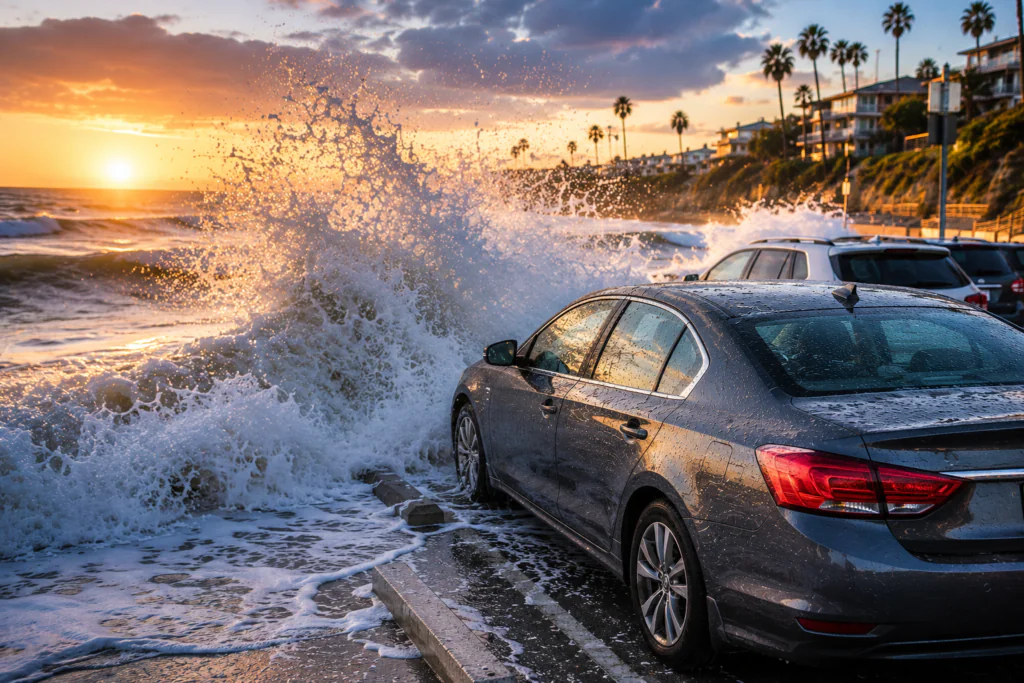
Can Saltwater Damage Your Car?
Yes. Saltwater can damage a vehicle because salt and moisture can contribute to corrosion of exposed metal and can leave deposits on paint and exterior surfaces. The potential damage depends on how much seawater reached the vehicle, which areas were exposed and how long the salt remained on those surfaces.
When ocean water starts reaching parked cars, a day at the beach can quickly turn into a vehicle-care concern.
That happened along the Southern California coast in late August 2026, when elevated surf sent waves into a beachfront parking area in Laguna Beach. According to KTLA, video showed seawater surging into the parking area and surrounding vehicles as dangerous surf and rip currents affected portions of the coast.
The scene raises an important question for Southern California drivers: Can saltwater damage your car?
Yes. Saltwater exposure can contribute to corrosion and can leave salt deposits on a vehicle’s paint, body and other exposed surfaces. But the amount of exposure matters. Ocean spray on the exterior of a car is very different from seawater rising high enough to flood parts of the vehicle.
Understanding that difference can help you determine what to do next.
A vehicle exposed only to ocean spray should not automatically be treated as flood damaged. A vehicle that has been partially submerged or had seawater enter its interior requires a much more cautious response and may need evaluation beyond an auto body shop.
What Happened Along the Southern California Coast?
KTLA reported on August 30, 2026, that a cooling trend was bringing some relief after weeks of hot weather across Southern California.
But the changing weather came with another concern.
A beach hazards statement was in effect through Monday afternoon for Ventura County beaches, the Malibu coast and Los Angeles County beaches, according to the National Weather Service information cited by KTLA.
Dangerous rip currents and breaking waves were possible as southerly swells moved through the region, with isolated waves reaching up to six feet.
KTLA also reported from Topanga State Beach, while video from Laguna Beach showed particularly relevant conditions for vehicle owners: waves crashing over the shoreline and surging into a beachfront parking area, surrounding vehicles with seawater.
The report did not provide an assessment of those vehicles or state that any particular vehicle sustained corrosion, paint, electrical or mechanical damage.
That distinction is important.
The Laguna Beach footage provides a useful example of potential vehicle exposure to ocean water, but it does not tell us what repairs—if any—the vehicles shown ultimately required.
How Can Saltwater Damage Your Car’s Paint and Body?
Cars in Southern California’s coastal communities are regularly exposed to salty air, but direct contact with seawater creates a more concentrated exposure.
Salt left on a vehicle can retain moisture. When that combination remains on susceptible metal surfaces, it can contribute to corrosion over time.
For the exterior of a vehicle, areas of concern can include:
- Painted body panels
- Existing paint chips or scratches
- Exposed metal
- Wheels and wheel areas
- Exterior trim and hardware
- Lower body panels
- Underbody areas reached by seawater
The condition of the vehicle before the exposure also matters.
For example, intact automotive paint provides a protective finish over the body surface. If an area already has chipped paint, a deep scratch or exposed metal, the underlying material may be more vulnerable to moisture and salt.
That’s one reason visible damage to the finish shouldn’t simply be ignored after significant saltwater exposure.
If you’re concerned about saltwater damage to car paint, an inspection can help determine whether you’re dealing with surface contamination, existing paint damage or an area that actually requires refinishing or repair.
Does saltwater immediately ruin automotive paint?
Not necessarily.
A brief exposure to ocean spray is not the same thing as leaving a vehicle partially submerged in seawater. Drivers shouldn’t assume that every splash of ocean water means their car needs body or paint repair.
The important factors include how much saltwater contacted the vehicle, where it reached, how long residue remained and whether the affected surfaces were already damaged.
The goal is to address salt contamination appropriately rather than automatically assuming the worst.
Is Ocean Spray Different From Saltwater Flooding a Car?
Yes—and this is probably the most important distinction in this article.
Consider three very different situations:
| Type of exposure | What it means |
|---|---|
| Ocean mist or spray | Salt residue may collect on exterior surfaces and should be removed appropriately. |
| Waves or seawater around the lower vehicle | More areas of the body, wheels and underside may have been exposed and could warrant closer attention. |
| Seawater enters or substantially floods the vehicle | This is a much more serious situation that may involve systems well beyond paint and auto body components. |
This distinction matters because Hovee’s Auto Body & Paint specializes in auto body, paint and collision-related repairs.
A vehicle that has actually been flooded by seawater can have potential concerns outside an auto body shop’s scope, including electrical and mechanical systems.
Drivers should not treat a flooded vehicle as simply a paint or body problem.
Should you drive a car that has been flooded by seawater?
If seawater has risen significantly around a vehicle or entered its interior, don’t assume the vehicle is safe to start or drive merely because it looks normal from the outside.
A substantially flooded vehicle may require evaluation of systems beyond exterior body and paint components.
This is very different from a vehicle that simply received ocean spray while parked near the beach.
What Should You Do If Seawater Gets on Your Car?
The appropriate response depends on the extent of the exposure.
For ordinary exterior salt contamination, removing salt residue from appropriate exterior surfaces is important. Drivers who routinely visit Southern California beaches may already be familiar with how quickly salt residue can accumulate on a vehicle.
If your car was exposed to more significant surf or standing seawater, however, take time to assess what happened before treating it like an ordinary car wash.
A reasonable approach includes:
- Determine how high the water reached. Look for evidence showing which areas of the vehicle were exposed.
- Document the vehicle. If the exposure was significant, photographs can establish where the vehicle was parked and what conditions it encountered.
- Look for visible body or paint damage. Pay particular attention to existing chips, scratches and exposed metal.
- Remove exterior salt contamination appropriately. Don’t allow obvious salt deposits to remain unnecessarily on painted and exposed exterior surfaces.
- Don’t assume a flooded vehicle is simply an exterior-cleaning problem. If water entered the vehicle or reached sensitive systems, seek appropriate professional guidance before starting or driving it.
- Have questionable body or paint areas inspected. If you see damaged paint, exposed metal or developing corrosion, determine whether repair is needed rather than simply covering the problem.
The response should match the exposure.
Someone whose vehicle received ocean mist doesn’t need to react as though the car was submerged. Conversely, a vehicle that sat in significant seawater shouldn’t be treated as though it only needs a rinse.
Can Saltwater Cause Car Body Corrosion?
Yes. Saltwater exposure can contribute to corrosion when salt and moisture remain in contact with susceptible metal surfaces.
For an auto body shop, one particularly important concern is damage that has already compromised a vehicle’s protective finish.
Imagine a vehicle has an existing deep scratch that exposes metal.
Now add saltwater.
That’s different from seawater landing on an intact painted panel.
This is where auto body repair and paint repair can become relevant. The objective isn’t simply to make a damaged area look better. Proper repair also restores the affected exterior surface rather than leaving damaged or exposed material untreated.
What does early corrosion look like on a car?
Drivers should pay attention to changes around previously damaged areas, including paint bubbling, discoloration, flaking or visible rust on exposed metal.
Those symptoms don’t prove that a single saltwater event caused the problem.
Corrosion can develop for multiple reasons and over different periods of time. An inspection is more useful than attempting to diagnose the cause from appearance alone.
Can Saltwater Damage a Car That’s Already Scratched or Chipped?
Existing damage deserves particular attention after exposure to salt and moisture.
Paint is more than a cosmetic color layer. A vehicle’s finish helps protect the body underneath it.
When scratches, chips or previous damage compromise that finish, the affected area may have less protection than an undamaged painted surface.
That doesn’t mean every chip exposed to ocean spray suddenly needs major body work.
It means vehicle owners should pay attention to existing damage rather than assuming all exterior surfaces have the same level of protection.
If paint damage has exposed the underlying surface, addressing the damaged finish can help restore protection as well as appearance.
When Does Saltwater Exposure Require Auto Body Repair?
Saltwater exposure by itself does not automatically mean a vehicle needs repair.
An inspection becomes more relevant when there is actual body or finish damage.
For example:
- Paint is deeply scratched or chipped
- Metal has become exposed
- Existing damage is beginning to show corrosion
- Exterior panels were physically damaged by waves, debris or another object
- Trim or body components were damaged during the event
- Corrosion has already affected repairable body areas
For older vehicles or vehicles with more extensive exterior deterioration, auto body restoration may sometimes become relevant.
But again, we shouldn’t confuse ordinary coastal exposure with a restoration project.
The appropriate repair depends on the vehicle’s actual condition.
What About Sand and Debris During High Surf?
Saltwater may not be the only concern when waves reach a parking area.
Strong surf can move sand and debris. If those materials physically contact a vehicle, they may cause scratches, dents or other exterior damage independently of the saltwater itself.
This is another reason to inspect what actually happened rather than assuming all damage associated with a coastal event has the same cause.
A scratch caused by moving debris is a different repair issue from salt residue sitting on intact paint.
And a vehicle physically struck by a substantial object presents a different situation again.
The correct repair begins with identifying the damage—not merely identifying the weather event that preceded it.
Southern California Drivers Face Unique Coastal Conditions
The August 2026 beach hazards described by KTLA weren’t limited to Laguna Beach.
The report cited warnings affecting Ventura County beaches, the Malibu coast and Los Angeles County beaches, and included reporting from Topanga State Beach.
For drivers throughout Southern California, beach parking is part of everyday life.
You don’t need to live directly on the coast to expose your vehicle to salt air, sand and ocean spray. Drivers from the San Fernando Valley regularly travel through Malibu, Topanga and other coastal areas.
That makes basic awareness of saltwater exposure worthwhile even if an event as dramatic as waves surging through a parking area is relatively unusual.
Frequently Asked Questions About Saltwater Damage to Cars
Can saltwater damage your car?
Yes. Saltwater can leave deposits on vehicle surfaces and contribute to corrosion of susceptible metals. The potential for damage depends on the amount and location of exposure and the condition of the affected surfaces.
Does ocean water damage car paint?
Ocean water doesn’t automatically ruin automotive paint. However, salt deposits should not be left unnecessarily on the vehicle, and existing chips, scratches or exposed metal may deserve closer attention after significant exposure.
Should I wash my car after driving near the ocean?
Removing salt residue from exterior surfaces is sensible after meaningful coastal exposure. Pay attention to areas where salt and sand can accumulate rather than focusing only on the most visible painted panels.
What should I do if ocean water reaches my parked car?
Determine how high the water reached and document significant exposure. If the vehicle only received exterior spray, appropriately removing salt residue may be sufficient. If seawater entered the vehicle or substantially flooded it, seek appropriate professional guidance before assuming it is safe to start or drive.
Can saltwater cause rust on a car?
Salt and moisture can contribute to corrosion on susceptible metal. Areas where paint or another protective finish has already been compromised can be especially important to monitor.
Can saltwater damage a scratched car?
A deep scratch or paint chip can leave underlying material less protected. Significant saltwater exposure makes it particularly important to inspect areas where metal is already exposed.
Is a car ruined if seawater gets around the tires?
Not necessarily. Water around the tires is very different from seawater entering the passenger compartment or reaching sensitive systems. The depth, duration and areas exposed determine the level of concern.
Can an auto body shop repair saltwater corrosion?
An auto body shop may be able to repair certain corrosion and paint/body damage, depending on its location and severity. A vehicle that has been substantially flooded can have electrical or mechanical issues requiring evaluation beyond auto body repair.
About the Southern California High-Surf Event
Event: Elevated surf and beach hazards
Reported: August 30, 2026
Areas mentioned: Laguna Beach, Topanga State Beach, Malibu coast, Los Angeles County beaches and Ventura County beaches
Conditions: Dangerous rip currents and breaking waves, with isolated sets reportedly reaching up to six feet
Vehicle-related observation: KTLA reported video showing waves entering a Laguna Beach beachfront parking area and surrounding vehicles with seawater
Relevant vehicle topics: Saltwater exposure, paint protection, corrosion, exterior body damage and coastal vehicle care
News source: KTLA
Concerned About Saltwater Damage to Your Car’s Paint or Body?
If coastal exposure has left your vehicle with damaged paint, exposed metal, exterior body damage or visible corrosion, determine what actually needs repair before the problem progresses.
Hovee’s Auto Body & Paint provides auto paint, auto body repair and restoration services from its Chatsworth facility. Hovee’s has been in the automotive industry since 1962 and has specialized in auto body repair since 1986.
Hovee’s Auto Body & Paint on Google
Hovee’s Auto Body & Paint
10034 Canoga Ave, Chatsworth, CA 91311
(818) 882-9999 | (818) 200-3685
Sources
Questions
Frequently Asked Questions
How do you handle rust repair?
Technicians remove corroded metal and replace affected panels, then refinish the area to prevent further corrosion and restore appearance.
What does auto body restoration involve?
Auto body restoration includes refinishing, custom work, customization, paint restoration, rust repair and restoring classic cars. The process can involve both exterior and interior work.
What makes Hovee’s different from other shops?
Hovee’s has been serving motorists since 1962 and specializes in auto body repairs since 1986. It uses approved equipment, employs highly trained technicians, uses high-quality materials and offers a lifetime warranty on bodywork and paint.
How experienced is your team?
The team has decades of experience and has served more than 16,000 satisfied customers. Hovee’s has been in the auto body business since 1986 and maintains a five-star rating.
Do you custom-match colors?
Yes. An onsite mixing color lab allows precise color matching and custom color solutions.
What types of damage can Hovee’s repair?
Hovee’s handles everything from minor dent and scratch repairs to major collision damage. Its comprehensive services cover dent removal, scratch repairs, frame straightening and paint matching.
What paint products do you use?
The shop uses high-quality paint and approved materials to ensure durability and a high-gloss finish.
Do you provide free consultations for restoration projects?
Yes. Customers can schedule a consultation, during which specialists will assess the vehicle and discuss restoration options.
Can you fix minor paint scratches?
Yes. Paint correction and scratch repair are part of the services. Technicians blend repairs so the scratch is not noticeable.
Do you offer free estimates?
Yes. The shop invites customers to call for a free estimate and also provides free appraisals using computerized estimating systems.

Hovee's Auto Body
Hovee's Auto Body has been in business since 1962 and has specialized in auto body and collision repair for over 40 years, exemplifying superior craftsmanship and unwavering dedication to customer satisfaction.
Hovee's Auto Body provides a full suite of services including: Collision Repair, Auto Body Repair, Auto Body Restoration, Auto Paint, Dent Repair, Bumper Repair, Structural Repair, Windshield Repair and Replacement, and Insurance Claim Assistance.
We proudly serve Chatsworth, Porter Ranch, Granada Hills, Northridge, Canoga Park, Winnetka, West Hills, Woodland Hills, Reseda, Tarzana, Encino, Mission Hills, North Hills, and the surrounding San Fernando Valley.
Keep Reading
Related Articles


Need Auto Body Repair in Chatsworth?
Contact Hovee's Auto Body & Paint today for a free estimate and trusted repairs backed by decades of craftsmanship.